




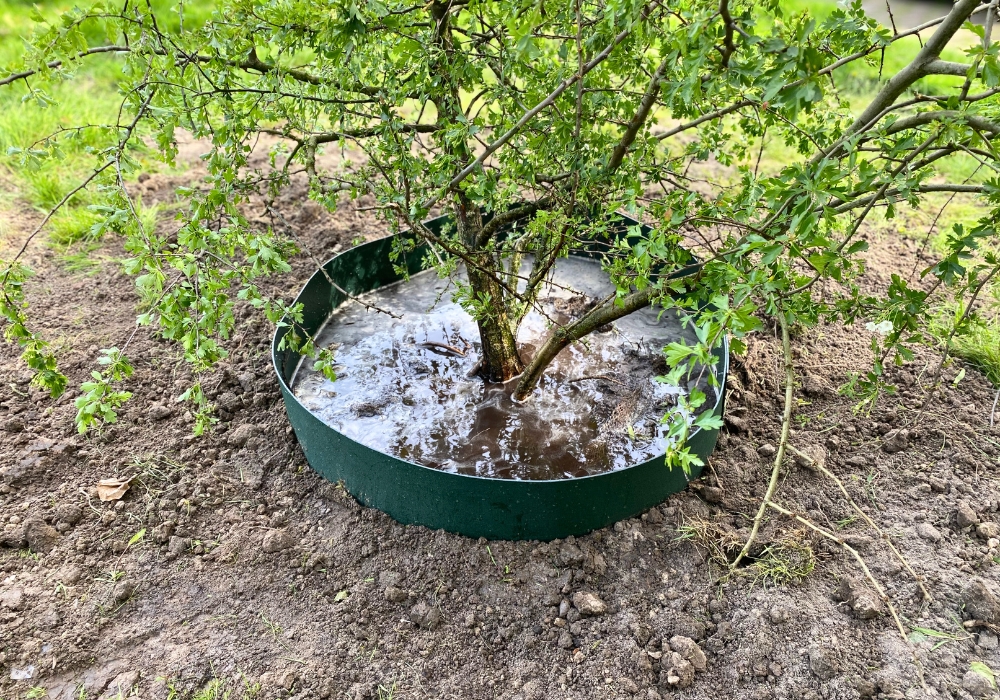
A tree needs enough water to keep the roots slightly moist and maintain the flow of sap. The exact amount depends on the tree’s age, species, soil composition and weather conditions. As a guideline for young trees: up to 200 cm in height about 3–5 litres per day, at 200–400 cm about 15–20 litres per day, and at 400–600 cm about 25–60 litres per day. Especially during dry periods, additional watering is necessary because rainfall does not always reach the roots.
What determines how much water a tree needs?
The amount of water a tree requires is mainly determined by the tree’s age, soil type, weather conditions and species. Newly planted trees need more water than established trees, sandy soil dries out faster than clay soil, and during warm weather or strong winds the water demand increases.
How does the age of a tree affect its water requirement?
Has the tree just been planted? In that case it needs extra support and it is important that enough water is available. The water should not run off but should reach the root ball and the roots. For this reason, it is advisable to install a water reservoir around young trees.
What is the function of a water reservoir?
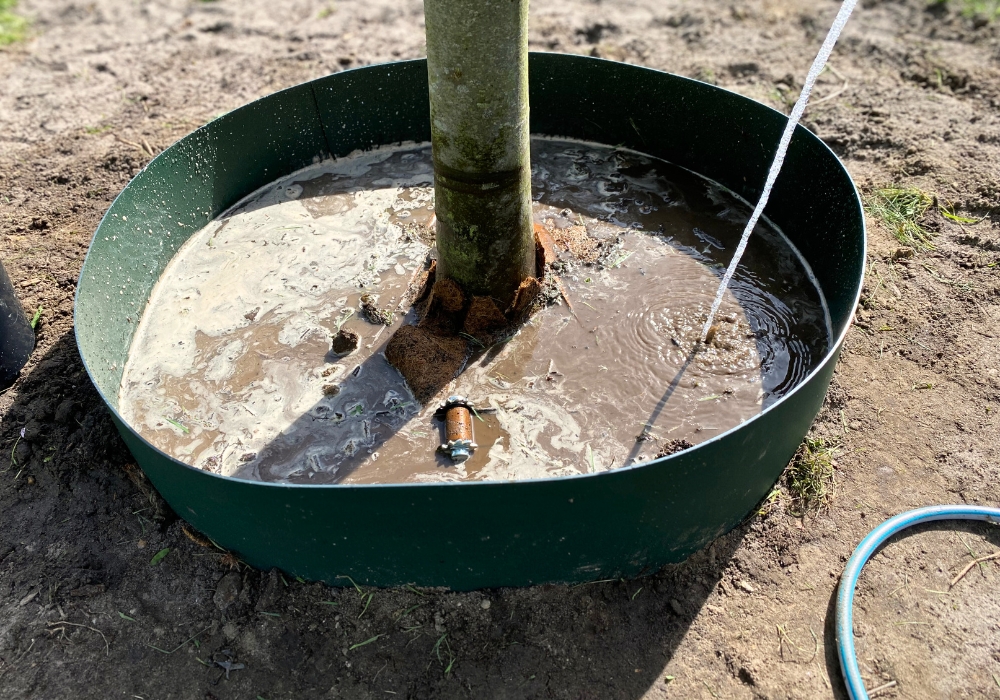
A water reservoir ensures that water sinks into the soil in the right place so the roots can absorb it properly. For newly planted root-ball trees, the water should reach the nursery root ball. The size of the water reservoir should be at least the diameter of the root ball. Leave the water reservoir in place for at least two full growing seasons. During this period new fine roots develop that eventually grow beyond the crown projection.
How do you recognise drought stress in established trees?
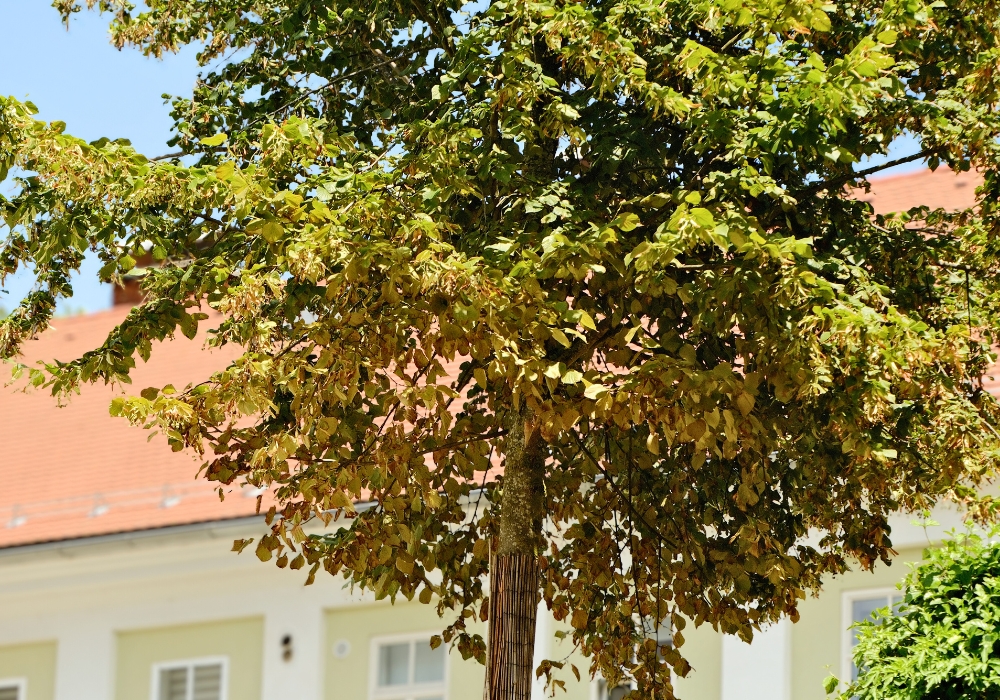
If the tree has been growing in the same place for some time, it is important that the root ball does not dry out. Drought stress can be recognised by drooping leaves, curling leaves, discolouration, leaves turning away from the sun or even leaf drop. At that point watering is actually already too late. It is therefore important to prevent these symptoms from appearing. Regularly check the soil directly next to the root ball. It should feel slightly moist.
What influence does soil type have on a tree’s water requirement?
Soil type largely determines how much water a tree needs and how often you should water it. Always check the soil moisture at around 10 cm depth in the root ball and the surrounding soil. This helps you decide whether additional watering is necessary.
Sandy soil or clay soil: what does this mean for water requirements?
In sandy soil water drains away more quickly and flows off more easily than in clay soil. As a result, a tree in sandy soil usually needs water more often or in larger amounts than a tree growing in clay soil. Clay soil retains water longer but may allow less oxygen to reach the roots during prolonged wet conditions.
How do weather conditions affect a tree’s water requirement?
Whether there is a lot or little rainfall, the most important factor is that the water actually reaches the root ball and the roots. Rainwater often falls outside the crown projection of the tree and therefore does not always penetrate the root zone. This means that even when it rains, a tree may still require additional watering to prevent the root ball from drying out.
Giving less water during prolonged rainfall: when is extra watering unnecessary?
During prolonged and heavy rainfall a tree needs less additional watering. From May to August, however, during dry weather with temperatures above 20 °C and low humidity, it is important to water more frequently or in larger quantities. This helps prevent the root ball from drying out.
Extra watering during hot and dry weather: increased water demand in summer
From May to August, particularly during dry weather with temperatures above 20 °C and low humidity, the water requirement increases significantly. Higher evaporation through the leaves and faster soil drying make it important to water more frequently or provide larger amounts of water. Regularly checking the soil moisture helps determine the correct amount of water for each tree and prevents both drought stress and overwatering.
Does the water requirement vary by tree species?
Water requirements vary by tree type and depend on characteristics such as leaf structure, growth rate and transpiration. By distinguishing between evergreen and deciduous trees in your watering schedule, you can better match the water supply to the growing season and prevent both drought stress and overwatering.
When do evergreen trees need water?
Evergreen trees that keep their leaves or needles throughout the year require water all year round. They continue to evaporate moisture even in winter. During dry winter periods, additional watering may therefore be necessary to prevent the root ball from drying out.
When do deciduous trees need water?
Deciduous trees lose their leaves in autumn. From that moment additional watering is usually no longer necessary because evaporation decreases significantly and the tree enters a dormant phase. Once the first leaves appear again in spring and the sap flow starts, the water requirement increases again. In practice, additional watering is usually needed from March until October or November, depending on temperature, rainfall and soil type.
Guidelines: how many litres of water does a young tree need per day?
For trees that have been planted in open ground for less than one year and have not yet completed a full growing season, we recommend the guideline below for daily watering. Young trees require additional water to develop a strong root system and to establish successfully.
| Total height of the tree | Recommended amount of water per day |
| < 200 cm | 3 to 5 litres per day |
| 200-400 cm | 15 to 20 litres per day |
| 400-600 cm | 25 to 60 litres per day |
These quantities are intended as general guidelines for the water requirements of young, newly planted trees. The actual amount of water required may vary depending on factors such as soil type, temperature, rainfall and location. No rights can be derived from these indications.
Watering a tree: when and how to do it correctly
Watering a tree correctly prevents problems such as drought stress or root rot. It is important not only to consider the amount of water but also the timing and the method of application. The following steps help you water a tree effectively.
Step 1: Check whether watering is necessary
Feel or measure the soil at around 10 cm depth near the root ball. The soil should be slightly moist. If it is dry, water the tree.
Step 2: Apply water in the right place
Ensure that water reaches the root ball and the roots. Rain does not always reach the root zone because much of it falls outside the crown projection.
Step 3: Choose the best time of day
Preferably water early in the morning or later in the evening. Less water evaporates at these times and it can penetrate the soil more effectively.
Step 4: Adjust watering frequency to the season and weather
From May to August, during dry weather with temperatures above 20 °C and low humidity, watering more frequently or with larger amounts is necessary. During prolonged rainfall additional watering is usually less important.
Step 5: Choose the right watering solution
Gebruik onderstaande keuzehulp om te bepalen wat het beste past bij jouw situatie:
| Watering solution | When to use it | Why choose it |
| Water reservoir* | For newly planted trees in open ground | Keeps water around the root ball and prevents runoff |
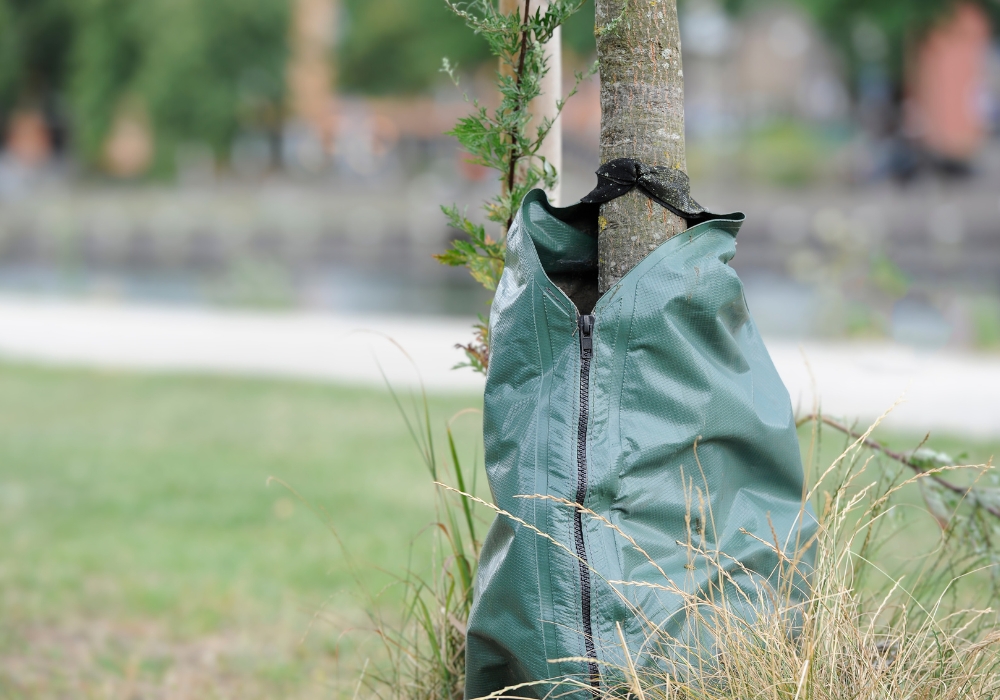
| AquaBag | For young trees that need slow, even watering | Releases water gradually over several hours and prevents both drought stress and overwatering |
| TreeDiaper | Where rainwater needs to be captured and slowly released | Stores rainwater and releases it gradually during dry periods |
| AquaMax | For trees in urban areas or planting beds requiring underground watering | Allows efficient watering beneath paved surfaces |
*Tip: place a coconut cover mat in the watering ring. When watering, for example with a large water tank, a large amount of water enters the watering ring at once. If mulch or sand is present, it can splash up and be displaced from the ring. A coconut mat prevents this problem. In addition, it suppresses weed growth, reduces evaporation, and stimulates soil life.
Step 6: Continue to monitor and adjust
Regularly check whether the root ball is drying out. Signs of drought include drooping or discoloured leaves and leaf drop. Adjust the watering amount based on what you observe in the soil.
Need advice about the right watering method?
Providing the correct amount of water is important for the growth and health of a tree. The best watering method depends on factors such as tree species, soil type, location, weather conditions and age. By adjusting watering to these conditions, you reduce the risk of failure and encourage strong root development.
Would you like to be sure which watering method is most suitable for your project? We are happy to think along with you and help find the right solution for healthy trees. Do not hesitate to contact us.
Last updated: 11 March 2026
- Article revised and expanded with practical guidelines for watering based on tree height.
- Added: step by step guide for watering trees correctly.
- New sections added on soil type, weather conditions and seasonal influences on water requirements.
- Overview table of watering solutions added, including a decision guide for different situations.
- Text updated and clarified to improve readability.
- Content verified by arborist Bert van Gils.
Published on: 17 December 2020