
Tree Root Guiding (TRG)

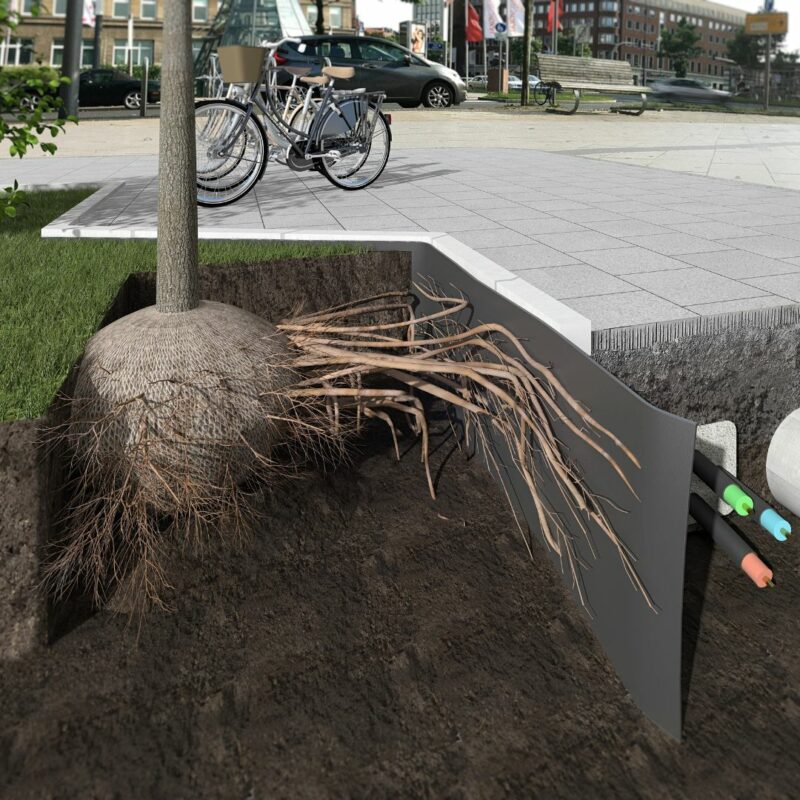
The Tree Root Guiding (TRG) root guidance system is designed to prevent root heave on paving and protect cables and pipelines. The special walls with guiding ribs direct the tree roots straight down and ensure that they grow horizontally under the panel. This keeps the tree stable and the paving intact.

Download leaflet

TRG for root guidance

Root guidance literally means guiding the roots in a certain direction. Similar to root protection, roots encounter a barrier in root guidance – in this case, a TRG root guidance panel. Our TRG panels are equipped with guiding ribs placed perpendicular to the panel. These ribs ensure that the roots are directed downwards once they hit the panel. Without these ribs, the roots would circulate along the wall, causing the tree to suffocate and lose stability. Once the roots reach the bottom of the panel, they continue to grow horizontally.

TRG provides tree stability

A conventional root protection system does not establish root guidance and therefore does not provide stability. Additionally, a conventional protection system can only be used from 2 meters away from the tree. If a root screen needs to be placed within 2 meters of a tree, it is necessary to use root guidance panels to ensure the stability of the tree.

TRG for new and existing trees

Tree Root Guiding root guidance is applied both for new plantings and after root cutting (renovation) to maintain the beauty and value of mature trees. Furthermore, it minimises the repair and liability costs of damaged pavements and the risk of tripping.

Preventing root overgrowth

TRG panels have a thickness of 2 mm, guiding ribs, root anchors, and a double top edge. This double top edge prevents root overgrowth. The panel always protrudes slightly above ground level so that roots cannot grow over the panel. The sturdy double edge allows for a visually clean and neat installation. This edge ensures that the edge does not get damaged, break, or cut when the screens are stepped on. A broken screen immediately provides escape opportunities for the roots, reducing the screen’s functionality.

Application of TRG

Protect the surrounding pavement on all four sides of the tree with the TRG root guidance panels. Utilise the entire available space within the tree pit for maximum uncompacted soil, sufficient growth space for the tree, and effective root guidance. Ensure there is enough space around the base of the tree trunk and take into account the future mature size.

TRG Sliding Panel

TRG Sliding Panels are, as the name suggests, extendable panels. These panels are suitable for any size planting hole and ideal for trees completely surrounded by paving, such as on squares and pavements. TRG Sliding Panels form a neat 90-degree angle and have a sturdy double edge that withstands being stepped on. The TRG Sliding Panel is available in two types: TRG45 Sliding Panel and TRG 60 Sliding Panel.

Frequently Asked Questions about Tree Root Guiding

Root guidance directs roots downwards. As with root protection, the roots encounter a barrier, which in this case is called a root guidance panel. These panels are fitted with guiding ribs positioned perpendicular to the panel. The ribs ensure that roots are guided downwards when they hit the panel. Once the roots reach the bottom of the panel, they continue to grow horizontally. Because the roots can continue to grow freely beneath the panel, the tree is able to stabilise properly. Unlike root protection, root guidance can therefore be applied within 2 metres of the tree.

Root heave is the process by which the roots of trees and large shrubs expand underground and exert pressure on paving. Simply put: the roots become so strong that they push up the paving and cause damage. This can range from sidewalks, bike paths, and roads to the foundations of buildings. When the roots become large and strong enough, this leads to cracks and subsidence.

Yes, Tree Root Guiding can be used very effectively as a cable duct. Tree Root Guiding has been developed to guide roots downwards in a controlled manner and to allow them to continue growing horizontally at the desired depth. It is important that the root guidance system is installed at the correct level, preferably 20 cm deeper than the cables and pipes and or down to the highest groundwater level. This ensures that cables and pipes remain well protected and, in the event of an emergency, it is clear where the cable duct is located. This allows engineers to carry out work quickly and safely without causing damage to tree roots.

High quality root guidance systems have a very long lifespan. The root guidance and root protection systems produced by GreenMax have a lifespan of more than 50 years. By applying these methods, the risk of damage to cables, pipes and paving is significantly reduced. This considerably lowers labour hours, costs and risks for municipalities, contractors and utility companies.

Yes, Tree Root Guiding prevents container-induced root circling. Container-induced root circling is the phenomenon in which roots continue to grow in circles and become entangled because they do not have sufficient space to extend further. With root protection, there is a risk that roots form one large root ball and begin to rotate without finding a suitable path into the subsoil. With root guidance, the roots are actively directed into the subsoil, after which they continue to grow horizontally at the bottom of the panel. Once there, they develop into anchoring roots, also known as support roots. This strengthens the stability of the tree and significantly reduces the likelihood of it toppling during a storm.

No, installing the Tree Root Guiding root guidance system is straightforward. Very little space is required to install the root guidance panels and there is minimal root removal of existing roots. With new planting, root removal is not necessary. In that case, the root guidance panels are installed during or shortly after planting. This allows young roots to be directed in the desired direction from the outset, without any need for root removal.

You only need to excavate slightly deeper than the existing foundation of the paving, so anchoring roots, also known as support roots, are not disturbed. A trenching bucket with a width of 23 cm is sufficient for this purpose. Tip: after installation, backfill the trench with a mixture containing soil improver. This stimulates the growth of new roots and ensures that the panel is firmly anchored.

Yes, applying the Tree Root Guiding root guidance system in situations with existing trees is straightforward. Very little space is required to install the root guidance panels and there is minimal removal of existing roots. You only need to excavate slightly deeper than the existing foundation of the paving, so anchoring roots, also known as support roots, are not affected. A trenching bucket with a width of 23 cm is sufficient for this purpose. Tip: after installation, backfill the trench with a mixture containing soil improver. This stimulates the growth of new roots and ensures that the panel is firmly anchored.

Yes, the groundwater level is an important factor in determining the height of the Tree Root Guiding root guidance system. Roots generally do not grow beyond the groundwater level, the fully capillary saturated zone. They also typically do not grow into the yellow sand layer in the soil profile. When dealing with a high groundwater level, cables and pipes are often installed within the groundwater, where roots do not grow. In that case, a low panel such as TRG45, 45 cm, can be used. We recommend positioning the panels at least 10 cm above the groundwater level. This ensures that roots do not come into conflict with cables and pipes, while still allowing maximum growing space, as the roots can continue to grow horizontally.

No, once properly installed, the Tree Root Guiding root guidance system requires little maintenance. However, periodic aftercare of the tree and the soil remains important, for example by ensuring sufficient water, nutrients and adequate aeration of the root zone.

Yes, the Tree Root Guiding root guidance system is modular in application. The system can be installed around an existing tree, for example during renovation works, or integrated into new planting schemes. To ensure that Tree Root Guiding can be precisely matched to the dimensions of the planting pit, TRG sliding panels are available. These allow clean 90 degree corners to be created and enable the panel to be adjusted exactly to the required length of the planting pit.

Yes, it may be necessary to use Tree Root Guiding root guidance panels of different heights within one planting pit. In some situations, cables and pipes are located on one side of the planting pit and paving on the other. In that case, it is advisable to install a high TRG panel on the side with cables and pipes, depending on the groundwater level. On the side where only paving is present, a lower TRG panel can be selected, allowing the roots more horizontal space for development.

Product specifications Tree Root Guiding (TRG)

Root Protection & Root Guidance Animation

Watch the video below to see how root barriers and root guidance look underground:

Want to learn more about the possibilities with TRG root guidance?

Request a no-obligation consultation with our experts or request a quote directly!

Relevant solutions for root protection & root guidance

ROOTBLOCK
VIEW MORE
ROOTCONTROL
VIEW MORE