




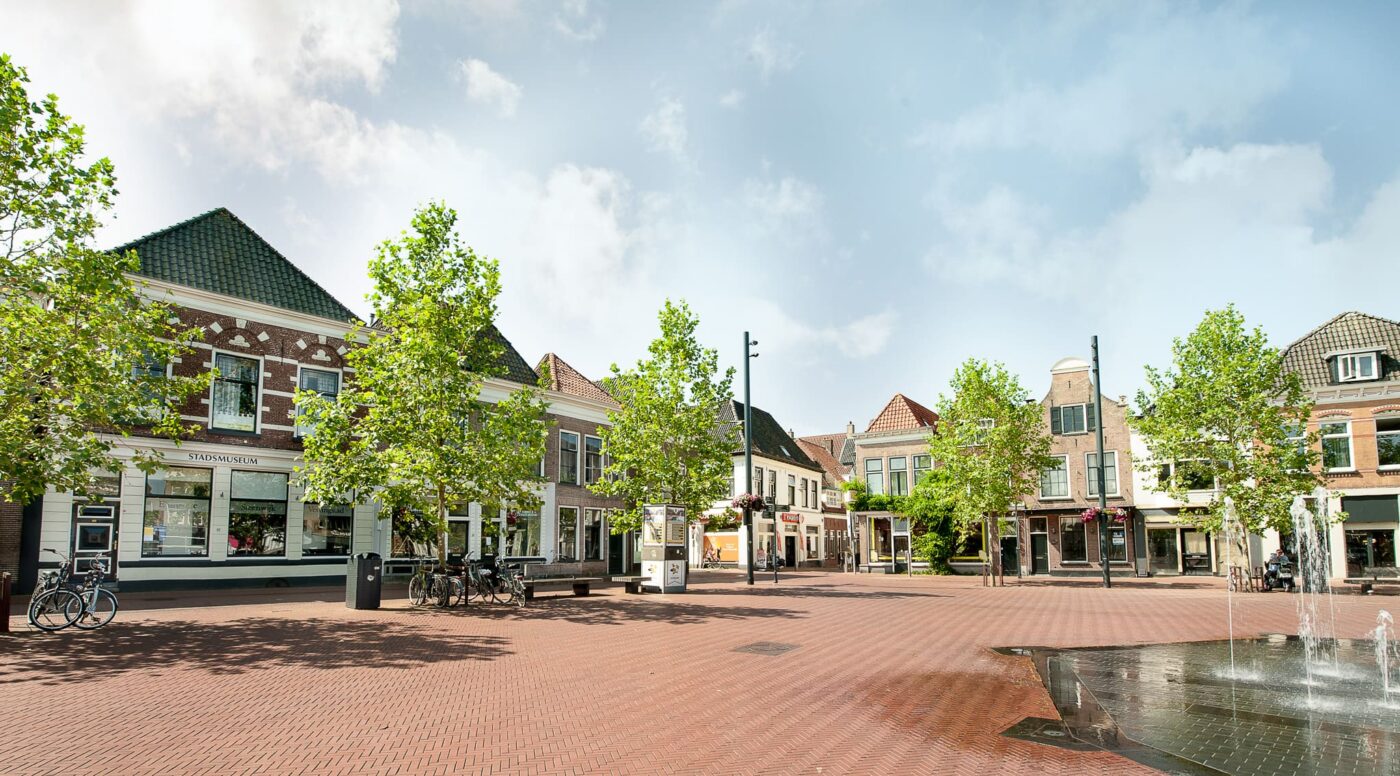
In public spaces, trees, paving and water storage increasingly share scarce underground space. At the same time, this same subsurface is intensively used for cables, pipes and foundations. When these functions are designed separately, conflicts arise below ground that manifest above ground as root heave, surface water flooding, soil compaction and trees that are under continuous stress. The challenge therefore lies not in introducing more measures, but in designing the subsurface intelligently and integrally. In this way, green, grey and blue no longer obstruct one another, but instead reinforce each other.
Where does it often go wrong in practice?
In public spaces, the subsurface is still commonly divided up functionally. Water storage is solved with separate facilities, trees are given a limited planting area, and paving is designed for maximum load-bearing capacity to ensure traffic safety and stability. Underground, these choices overlap, with far-reaching consequences:
- No space for root growth
- Root heave causing damage to paving
- Soil compaction
- Disrupted water management
- Insufficient water and oxygen for the tree
- Trees under long-term stress
Integrated design bringing together root growth, water storage and infrastructure
Integrated design means approaching the subsurface as one coherent system in which multiple disciplines are accommodated simultaneously. A practical way to combine trees, paving and water storage is the use of a soil cell system. The TreeParker soil cell system is an underground structure that provides trees in paved areas with an optimal tree pit. The system is suitable for both new and existing trees.
Withstanding the heaviest traffic loads
The TreeParker system is designed to carry the heaviest traffic loads, preventing soil compaction and allowing roots to develop freely within the soil cell system. The space is often filled with a specialist tree substrate that is both permeable and rich in nutrients. The soil cell system consists of a modular structure installed below ground level.

Optimal stormwater management
The TreeParker soil cell system can be perfectly combined with water management solutions. By connecting the system to a gully, rainwater is temporarily stored within the tree pit. This water is then gradually released to the tree during dry periods, reducing drought stress while significantly lowering the risk of surface water flooding or inundation above ground.
Paving remains intact
To prevent roots from growing towards the paving and causing damage, Tree Root Guiding root guidance is applied within the TreeParker system. Root guidance actively directs roots from the outset towards safe growth zones within the soil cell system and away from paved surfaces. This keeps paving stable while still providing the tree with sufficient space to grow healthily.
Integration of cables and pipes
In addition to space for controlled root growth and water storage, a soil cell system also offers opportunities to integrate cables and pipes. By consciously designing infrastructure within or alongside the soil cell system, cables and pipes remain accessible for management and maintenance, while being physically separated from the root system. This prevents damage caused by root growth, reduces the risk of failures and ensures that trees and underground utilities can function sustainably alongside one another.
By combining water storage, growing space, root guidance and utilities, an integrated and future-proof design is created that prevents root heave, improves water management and allows trees to grow old in good health.
Overview: combining functions in one underground system
This overview shows how various challenges in public spaces can be addressed by applying an integrated design principle. A soil cell system combines water storage, trees and paving in one solution and even offers possibilities for integrating cables and pipes.
Function in the public space |
Problem without an integrated approach |
Integrated design principle |
|
Trees and root growth |
Poor growth, instability and limited lifespan |
TreeParker soil cell system with sufficient rootable volume, aligned with the intended lifespan of the tree in accordance with the Tree Monitor of the Dutch Institute for Tree Assessment |
|
Water storage and water management |
Surface water flooding during heavy rainfall or drought during dry periods |
Connecting the TreeParker soil cell system to rainwater drainage so that water is buffered and purposefully used for tree irrigation, without causing surface water nuisance |
|
Paving |
Soil compaction, root heave and damage to paving |
TreeParker soil cell system with load-bearing capacity for the heaviest traffic loads, combined with a Tree Root Guiding root guidance system to direct roots away from paving |
|
Underground cables and pipes |
Lack of space, damage, limited accessibility and increased risk during maintenance or redevelopment |
Integration of cables and pipes within the TreeParker soil cell system, incorporating a separate, accessible zone or duct that is physically separated from the root volume |

Why an integrated design works better in the long term
By carefully considering the combination of different functions in public spaces from the outset, a smart and future-proof infrastructure is created. An integrated design:
- Prevents underground conflicts by aligning green, grey and blue elements from the start
- Improves tree health and lifespan through optimal tree pit design
- Supports robust water management in which rainwater is buffered, infiltrated and reused rather than discharged
- Limits damage to paving and underground infrastructure by guiding root growth and separating structures from root systems
- Reduces management, maintenance and repair costs by creating a predictable, accessible and maintenance-friendly subsurface
Summary
Water storage, trees and paving can be successfully combined by designing the subsurface integrally rather than treating functions in isolation. By combining sufficient growing space for trees with water buffering, robust water management and a load-bearing structure from the outset, underground conflicts are avoided. The result is a future-proof public space in which trees can grow healthily, rainwater is used efficiently and paving remains safe and stable, with lower management and repair costs in the long term.
